
Full Mix Modelling
With increasingly tight budgets and rising media costs, understanding what brings revenue into a business is key to making decisions on how to invest your marketing spend to deliver a better ROI. That’s why you need econometrics.
“We’ve leveraged econometric insights to optimise media spend, resulting in significant ROI improvements and strategic growth.”
Lewis Kimber, Head of Acquisition and Trading

What is econometrics?
In short, it’s a way of doing marketing attribution – that is, working out how many incremental sales (or other KPI) are being driven by each element of your marketing mix.
Whilst it’s not the only form of marketing attribution (spot matching, linear tracking, Google Analytics, last-click, multi-touch attribution and even asking people ‘How did you hear about us?’ are all alternatives), econometrics is the only approach that works across all drivers, sizing their contribution and putting them on a level playing field.
How does it work?
It’s an advanced statistical process (known as “multivariate linear regression”) that analyses the relationships between multiple drivers, simultaneously, and works out the contribution of each to total sales.
At MetaMetrics, we have been long-term advocates of Bayesian analysis which is an even more advanced technique allowing us to extract even more information from your data.
What KPIs can be used in an econometric model?
Econometric modelling is the only technique capable of disentangling all of the many drivers of your KPIs. It’s most used to explain ‘hard’ metrics such as sales, customer acquisition and donations.
However, we often use it to understand the drivers of other KPIs, such as web visits, brand health metrics, service usage and many others. In short, any measure of consumer response, for which you have continuous data over a period of time, can be modelled.

What drivers does a full econometric model measure?
A common misconception is that econometric modelling only measures the impact of media drivers. Whilst it can be (mis)used in this way, it only really works – and the results are only really valid – if we analyse all significant sales drivers, both media and otherwise. It varies by brand, but that might include:
- Market growth or decline
- Price changes
- Promotional activity
- Seasonality and weather
- Economic factors, such as interest rates, or consumer confidence
- Competitor activity
Econometrics is what we like to call ‘data agnostic.’ It doesn’t care what the nature of the driver data is; it just sees it as data and looks for correlations. This is why it also needs careful analysis and human interpretation to ensure it doesn’t give spurious results. Much of our work at MetaMetrics is spent doing just this.
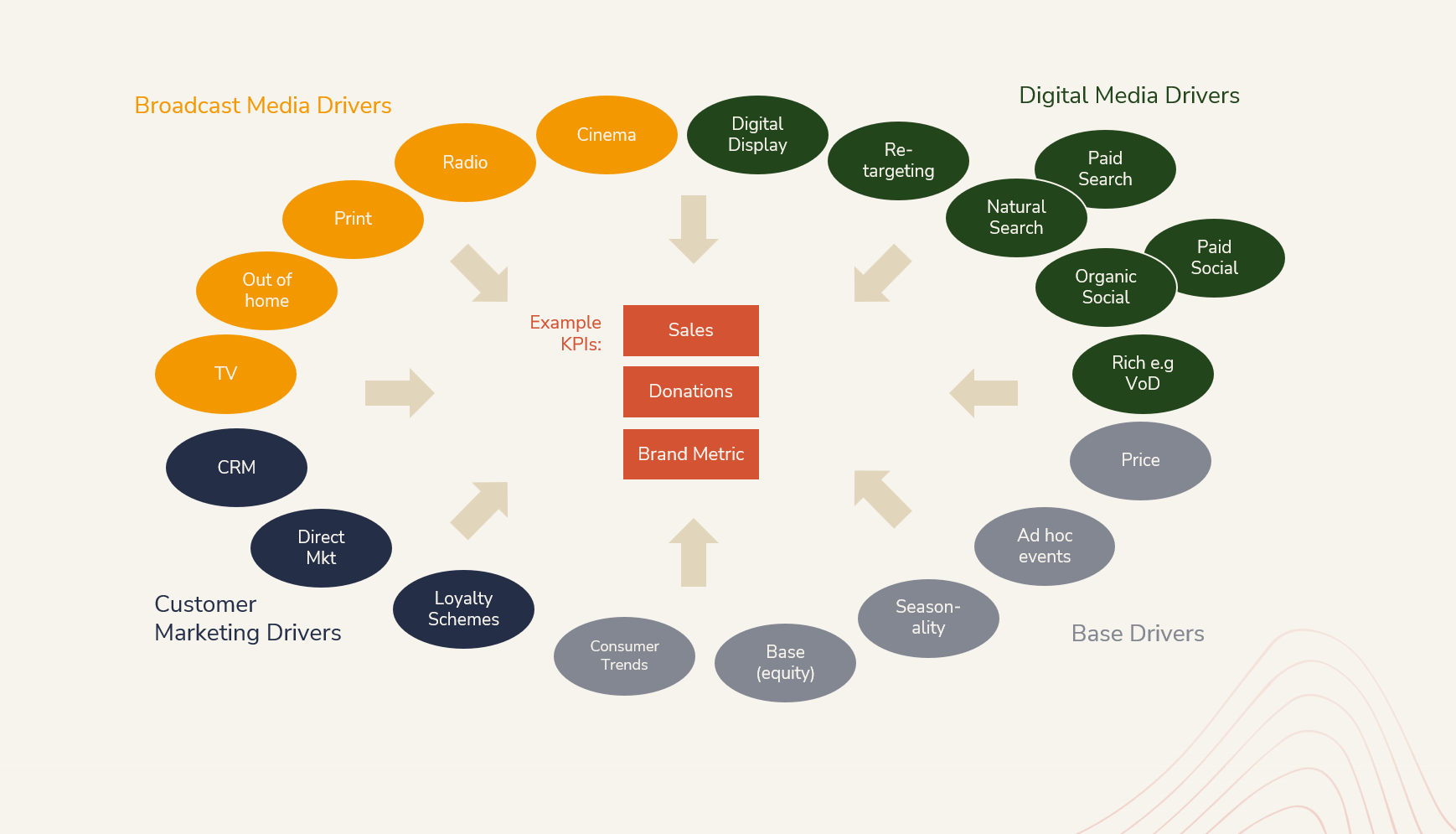
Ways that an econometric model could help
-
- Unpick the ‘DNA’ of your business to understand what drives your KPIs
- Prove the value of your marketing – channel by channel
- Optimise your marketing budget, allocation and deployment to drive performance
- Provides recommendations for each media channel to optimise return on investment
- Provides forecasts and simulations of different investment scenarios to inform planning
- Measures softer, response-based metrics such as brand health indices – awareness, consideration, purchase intent etc.
If you’d like to get more under the econometrics bonnet, download our free eBook ‘Guide to Econometric Modelling’.
Is Econometric Modelling Right for Your Business?
Surprisingly, not necessarily. As people who build econometric models for a living, we spend a surprising amount of time with potential clients, helping them understand whether an econometric project is right for them.
This is a bigger topic than we can tackle here, but you might want to consider doing an econometric project if you have:
- A question about your media that you would like an answer for
- A budget to optimise
- A dataset to model
A full econometric model can give you just this clarity.